The history of art cannot be understood without the contributions of women. However, their presence in museums, collections, and historiographical narratives has traditionally been less than that of men, an inequality that cultural institutions continue to review through new research, acquisitions, and exhibitions.
On the occasion of International Women's Day, we take a look at the careers of five contemporary Spanish artists who have explored disciplines as diverse as performance, computational art, sculpture, printmaking, and photography.
1. Esther Ferrer

Esther Ferrer, The Artist's Hands, 2023, signed and hand-numbered lithograph, 50.2 × 35.1 cm, edition of 60 copies + 5 APs. Work available in our Art Shop
The work of artist Esther Ferrer (San Sebastián, Spain, 1937) primarily develops in the fields of performance art, photography, drawing, collage, installation, and sound and radio creation. Her work is linked to minimalist and conceptual practices that emerged in the 1960s, as well as to the processes of art dematerialization, and it dialogues with feminist thought and reflections on the body, time, identity, and the condition of women.
Ferrer is considered one of the main representatives of performance art and one of the pioneers of action art in Spain. Her artistic practice, along with her critical and written activity, has contributed to questioning social and artistic conventions and to giving visibility to issues related to gender and the representation of women.
In 1999, she represented Spain, along with Manolo Valdés, at the Venice Biennale. In 2008, she received the National Plastic Arts Award; in 2012, the Basque Government's Gure Artea Award, in recognition of her career; and in 2014, she was honored with the MAV Award for Women in Visual Arts, the Prix Marie Claire de l'Art Contemporain, and the Velázquez Plastic Arts Award.
2. Elena Asins
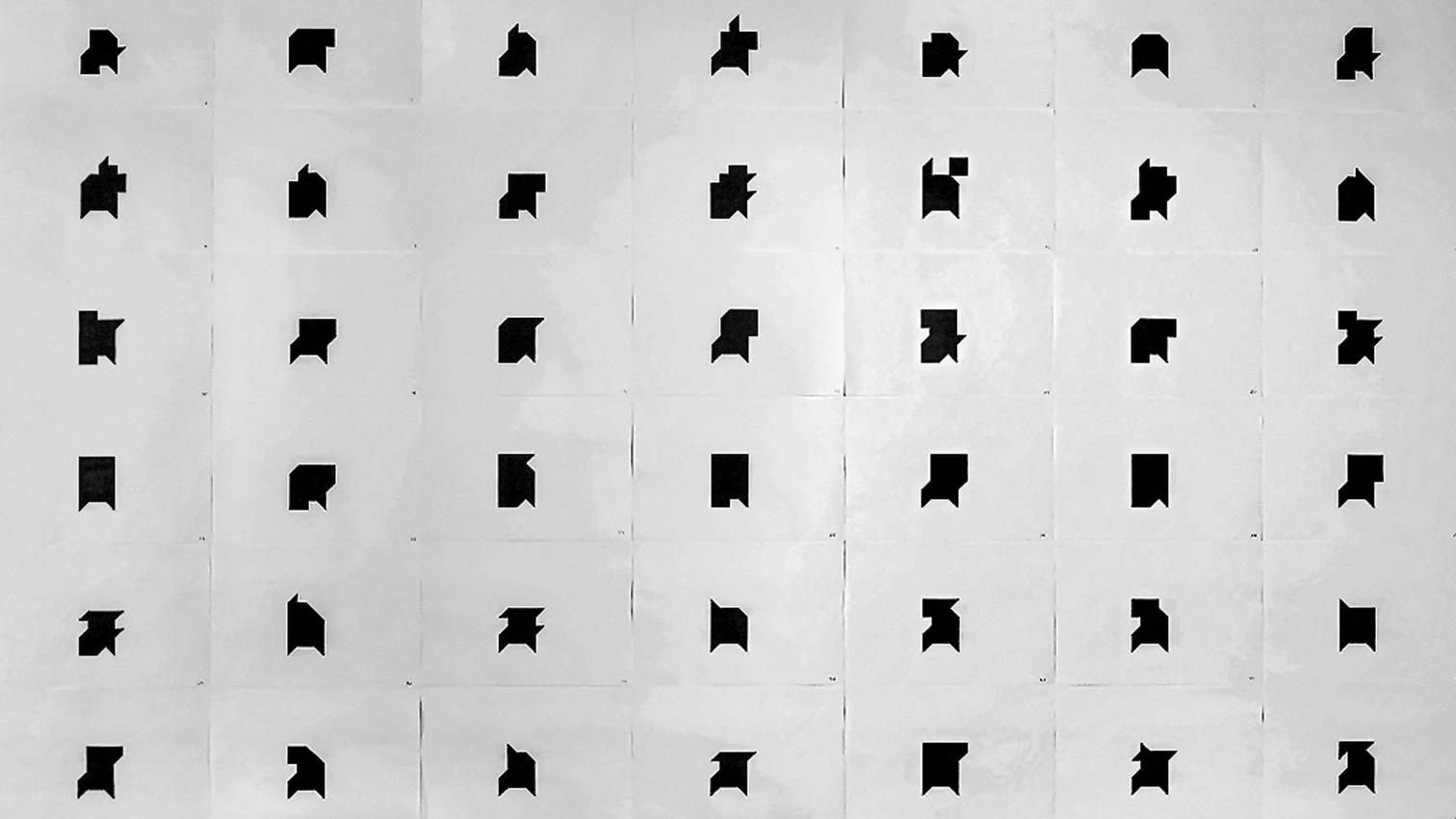
Elena Asins, Canons 49, 1989, print on paper, 143 x 210 cm
Elena Asins (Madrid, 1940-Azpíroz, Navarre, 2015) is considered one of the pioneers of computational art in Spain. Her work links the constructive and geometric tradition of 20th-century avant-gardes with mathematics, computer science, and aesthetic research developed since the 1960s.
She was involved in some of the most innovative projects in Spanish art of those years, including the Cooperative of Artistic and Artisan Production and the Seminar on Automatic Generation of Plastic Forms at the Calculation Center of the University of Madrid, now part of the Complutense University of Madrid.
Throughout her career, she worked with numerous formats and media, such as drawing, experimental poetry, sculpture, video, and installation. Her production is characterized by compositional rigor, formal refinement, and the systematic application of mathematical principles and geometric structures.
3. Cristina Iglesias

Cristina Iglesias, Untitled Room XI, 2003, signed serigraph on silk, 83 × 71 cm, edition of 25 copies. Work available in our Art Shop
Cristina Iglesias Fernández Berridi (San Sebastián, 1956) is a Spanish sculptor and installation artist, considered one of the most internationally renowned Spanish creators of recent decades. She trained in sculpture at the Chelsea School of Art in London between 1980 and 1982.
Since the early 1980s, her work has contributed to renewing the contemporary conception of sculpture, exploring the relationships between the work, architecture, landscape, and the experience of space. Her installations often create traversable and immersive spaces, featuring architectural structures, lattices, passageways, surfaces with a vegetal appearance, and flowing water.
Throughout her career, she has used a wide variety of materials, including steel, iron, bronze, concrete, alabaster, resin, glass, silk, and water, as well as elements inspired by plant and geological forms. Her practice also encompasses techniques such as bas-relief, tapestry, engraving, and large-format serigraphy on supports such as silk or copper.
Iglesias represented Spain at the Venice Biennale in 1986 and again in 1993. In 1999, together with Pablo Palazuelo, she received the National Plastic Arts Award, granted in recognition of her international prominence and her contribution of new paths to the plastic arts.
4. Isabel Muñoz

Isabel Muñoz, Untitled, signed and hand-numbered photolithograph. 65 × 50 cm. Edition of 85 copies. Work available in our Art Shop
Isabel Muñoz Vilallonga (Barcelona, 1951) is a Spanish photographer based in Madrid, where she has developed much of her professional career. The human body is one of the central themes of her work, especially through portraiture, dance, and movement. Her photographs explore issues related to identity, cultural diversity, human rights, and the environment.
Her work is characterized by attention to forms, light, and details, as well as by constant research into photographic techniques and media. Among the procedures she has most used, platinotypy stands out, along with video, digital printing, and other experimental media. This combination of technical precision and experimentation allows her to construct images of great visual and tonal richness.
Throughout her career, she has received numerous awards. She won two World Press Photo awards: second prize in the Arts and Entertainment category in 2000, for a series made at the Shaolin Temple, and third prize in Portraits in 2005, for her work on the Suri people of Ethiopia. In 2016, she received the National Photography Award and, in 2023, she became a full academician of the Royal Academy of Fine Arts of San Fernando.
5. Blanca Muñoz

Blanca Muñoz (Madrid, 1963) trained at the Faculty of Fine Arts of the Complutense University of Madrid. Her artistic practice develops primarily in the fields of sculpture and printmaking.
In her sculptural pieces, she uses materials such as stainless steel, perforated sheet metal, wire, and wire mesh, with which she creates open volumes that dialogue with light and space.
The artist has also explored the three-dimensional possibilities of printmaking by incorporating reliefs, cut-outs, and metallic elements, thus blurring the boundaries between print and sculpture.
In 1999, she received the National Printmaking Award from the Calcografía Nacional and, in 2021, she took office as a full academician of the Royal Academy of Fine Arts of San Fernando.
Five careers, multiple ways of understanding art
Esther Ferrer, Elena Asins, Cristina Iglesias, Isabel Muñoz, and Blanca Muñoz belong to different generations and disciplines. Their careers allow us to trace some of the transformations experienced by Spanish contemporary art: from the consolidation of performance and computational creation to the renewal of sculpture, printmaking, and photography.
Approaching their works not only allows us to recognize their individual contributions but also to better understand the evolution of Spanish contemporary art and the variety of languages that comprise it.
To discover more works of Spanish and international contemporary art, visit our Art Shop, where you will find a curated selection made by our experts.