What happened?
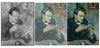
The Courtauld Institute of Art has discovered a face underlying the well-known portrait of Mateu Fernández de Soto (1901).
The painting, whose subject was an important figure in the life of the Malaga-born painter, is presented to us today in a completely new light with the revelation of a woman's face that has remained hidden for over a century.
The mysterious figure was discovered by chance while the work was being examined prior to its exhibition as part of the Oskar Reinhart Collection.
Have you ever wondered how experts see through layers of paint? RedCollectors explains it to you simply.
How do they do it?
Several different techniques can be used to study a painting, although the article published by the Courtauld Institute shows that they used the following.
-
X-ray analysis
Since X-rays are able to penetrate matter, radiography can show how paint layers have been applied and some of the materials used (such as the canvas mounting itself).

-
Infrared analysis
Infrared radiation allows for the study of the underlying drawing (i.e., the layers beneath the surface), reveals "pentimenti" (changes made during the painting process), detects previous restorations, and can also reveal hidden details such as inscriptions or signatures.

Once seen, it cannot be unseen.
The most interesting thing is that once the image of the woman has been seen, her outline seems to be distinguishable even to the naked eye.

Why is it important?
"Pentimenti" in the art world are very interesting, as rather than being seen as flaws in the work, they are considered a useful research tool. Being able to see an artist's creative process, and especially what they choose not to show, provides great insight into their mind and working method.
Consequently, it also provides more clues about the way an artist, who sometimes seems to be fully understood, actually worked.
We are accustomed to a mythologized figure of Picasso, almost solely limited to his Cubist style. However, this news gives visibility to one of the paintings from his Blue Period, in which he investigated symbolism and which is characterized by a tone of sadness and melancholy.
The sketch of the woman also seems to belong to the artist's earlier style, late Impressionism, so the work represents the transition from one pictorial style to a new one.