Mary Beth Edelson, Some Living American Women Artists/Last Supper, 1972. Cut and pasted gelatin silver prints, crayon, and transfer letters on printed paper, with typed text on cut and taped paper. 71.8 × 109.2 cm. Collection of the Museum of Modern Art (MoMA), New York.
Contemporary collecting requires a critical, independent eye, capable of recognizing the biases that have shaped both art history and market formation. For centuries, numerous female artists were relegated in academic narratives, linked to the workshops of their male counterparts, or excluded from major spaces of training and legitimation.
In her essay Why Have There Been No Great Women Artists? (1971), Linda Nochlin analyzed how different social, cultural, and institutional factors limited women’s access to artistic education and professional recognition. One of these factors was their exclusion from the study of the nude model, which was essential for competing in history painting, then placed at the top of the academic hierarchy. As a result, many women artists found greater opportunities in portraiture, still life, and scenes of everyday life, genres then considered to have lower institutional status.
Despite these barriers, numerous painters worked for courts, participated in avant-garde movements, promoted new trends, and developed languages that influenced their contemporaries. Today, the review of authorship, archives, collections, and exhibition discourses is restoring visibility to these trajectories and strengthening their institutional and commercial presence. Museums such as the Prado, the Tate, and the MoMA have contributed to this process through new research, exhibitions, and revisions of their collections.
For collectors, this transformation opens new lines of analysis. Historiographical relevance, presence in museums and exhibitions, provenance, authenticity, state of conservation, and bibliography allow for a more rigorous evaluation of each work. Incorporating a gender perspective into a private collection or a corporate collection expands the narrative of the whole and helps identify trajectories that received limited attention for years. At ArteGlobaL, we understand that knowing the trajectory of the best female painters of all time allows us to analyze each acquisition with artistic, documentary, and market criteria; from this perspective, we review the careers of 15 top female painters who changed art history, from the Renaissance to contemporary times.
Renaissance and Baroque Painters
In a context that limited women's access to training, guilds, and professional commissions, some female painters managed to develop recognized careers and work for European courts and collectors.
1. Sofonisba Anguissola

Sofonisba Anguissola, Self-Portrait at the Easel, c. 1556. Oil on canvas, 66 × 57 cm. Museum-Castle in Łańcut, Łańcut, Poland.
Born in Cremona, Sofonisba Anguissola (1535-1625) developed her career at a time when few women could access professional art training. Her family portraits and self-portraits show her interest in gestures, family relationships, and the psychological characterization of her subjects.
In 1559, she was invited to the Spanish court of Philip II. There she served as a lady-in-waiting to Queen Elisabeth of Valois and continued painting portraits. Her presence in Spain represents one of the first documented cases of a female painter associated with a major European court.
2. Artemisia Gentileschi
 Artemisia Gentileschi, Judith Beheading Holofernes, c. 1620. Oil on canvas, 199 × 162 cm. Uffizi Gallery, Florence.
Artemisia Gentileschi (1593-1654) initially trained in her father Orazio Gentileschi's workshop. Her painting is associated with naturalism and the light contrasts linked to Caravaggio's circle, though she developed her own path between Rome, Florence, Venice, Naples, and London.
During her stay in Florence, she entered the Accademia delle Arti del Disegno. She was one of the first women admitted to this institution. In paintings like Judith Beheading Holofernes, she tackled biblical narratives through large-format compositions.
3. Clara Peeters
 Clara Peeters, Table, 1611. Oil on panel, 52 × 73 cm. Museo Nacional del Prado, Madrid.
Clara Peeters' biography remains partially unknown. The Prado Museum places her birth around 1588-1590 and considers it probable that she developed her career in Antwerp. Her earliest known dated work is from 1607.
She was one of the first European female painters to specialize in still lifes. She depicted food, flowers, and metal objects with particular attention to their textures and reflections. In several compositions, she included small self-portraits reflected in cups and pitchers.
4. Judith Leyster

Judith Leyster, Self-Portrait, c. 1630. Oil on canvas, 74.6 × 65.1 cm. National Gallery of Art, Washington D.C.
Judith Leyster (1609-1660) worked in Haarlem and painted portraits, musical scenes, and figures related to daily life. In 1628, she was already mentioned as an active artist in a description of the city when she was around nineteen years old.
For a long time, her name disappeared from part of art history, as several of her paintings were attributed to Frans Hals and other artists. Her artistic identity began to be recovered in the late 19th century, when her monogram was identified and earlier attributions were reviewed. Her Self-Portrait, held at the National Gallery of Art in Washington, shows Leyster working at her easel and visually affirms her professional status.
From Impressionism to the Avant-garde
Between the late 19th and early 20th centuries, some artists actively participated in new exhibition spaces and movements that transformed modern art. Berthe Morisot and Mary Cassatt were part of Impressionism, while creators like Sonia Delaunay, Natalia Goncharova, and Hilma af Klint contributed to explorations of color, abstraction, and the relationship between art and everyday life.
5. Berthe Morisot
 Berthe Morisot, Summer Day, c. 1879. Oil on canvas, 45.7 × 75.2 cm. National Gallery, London.
Berthe Morisot (1841-1895) participated in seven of the eight exhibitions organized by the Impressionists between 1874 and 1886. She painted gardens, interiors, family scenes, and figures from her environment using visible brushstrokes and compositions built from light.
The Musée d’Orsay places her among the central figures of Impressionism and the Parisian avant-garde of the late 19th century. Her works allow for the study of both the development of Impressionism and the social spaces accessible to a woman of her standing during the second half of the 19th century.
6. Mary Cassatt

Mary Cassatt, La coiffure, 1991. Drypoint and color aquatint on laid paper, approx. 36.2 × 26.7 cm (plate). Available in our shop.
Mary Cassatt (1844-1926) was born in the United States and developed much of her career in France, where she participated in Impressionist exhibitions. She frequently depicted women and children reading, traveling, attending the theater, or sharing scenes of daily life.
During the 1880s, she delved into printmaking techniques. A decisive moment came in 1890, when she visited an exhibition of over seven hundred Japanese prints at the École des Beaux-Arts in Paris. Contact with ukiyo-e influenced her compositions, her treatment of the figure, and her use of flat surfaces, defined contours, and areas of color. In our shop you can explore some available works from this period and delve into her graphic production.
7. Sonia Delaunay
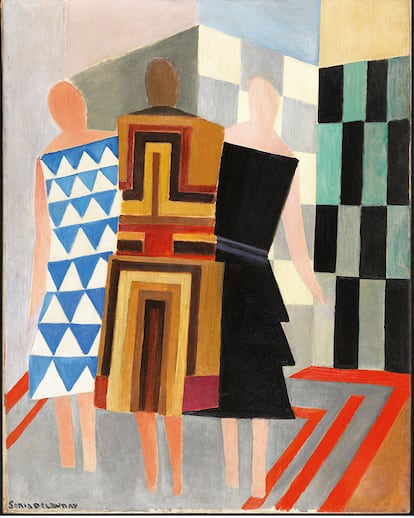
Sonia Delaunay, Simultaneous Dresses (Three Women, Shapes, Colors), 1925. Oil on canvas, 146 × 114 cm. Museo Nacional Thyssen-Bornemisza, Madrid.
Sonia Delaunay (1885-1979) investigated the relationships between colors through paintings, books, textiles, dresses, stage designs, and design objects. Along with Robert Delaunay, her work became associated with simultanism and chromatic investigations linked to abstraction.
One of her main contributions was extending these principles beyond the canvas. During the 1920s, she applied her compositions to fashion and fabrics, transferring artistic experimentation to clothing and everyday spaces. In 1918, she opened Casa Sonia in Madrid, dedicated to her clothing and interior designs.
8. Natalia Goncharova

Natalia Goncharova, Rayonist Lilies, 1913. Oil on canvas, 91 × 75 cm. Perm State Art Gallery, Perm, Russia.
Natalia Goncharova (1881-1962) was part of the Russian avant-garde movements of the early 20th century. Although she was familiar with Cubism and Futurism, she developed her own language that combined these investigations with history, popular culture, and Russian visual traditions.
In 1912, along with Mikhail Larionov, she participated in the formulation of Rayonism, a movement focused on representing the interaction of light through lines and planes of color. Her work extended beyond painting to include drawing, illustrated books, stage design, and costume. She collaborated on nearly twenty Futurist publications and designed sets and costumes for over thirty plays and ballets. In 1919, she settled in Paris, where she continued to develop painting and stage projects.
9. Hilma af Klint

Hilma af Klint, Altarpiece, No. 1, Group X, Altarpieces, 1915. © Stiftelsen Hilma af Klints Verk.
Hilma af Klint (1862-1944) received an academic education in Stockholm and initially worked on portraits, landscapes, and botanical studies. From 1906, she began to create abstract compositions constructed using circles, spirals, diagrams, letters, and geometric structures. Her work was linked to her interests in spiritualism, theosophy, philosophy, and natural sciences, and many of her paintings were conceived as interrelated series intended for a specific exhibition space.
These works emerged before abstraction was publicly consolidated in European art. For this reason, the Guggenheim Museum considers that her production between 1906 and 1920 compels a re-examination of both the development of modernism and traditional narratives about the origins of abstract painting.
20th Century Artists
Throughout the 20th century, various artists expanded the themes and languages of painting from very diverse cultural and biographical contexts. Georgia O’Keeffe developed a new relationship with the landscape and natural forms of New Mexico; Frida Kahlo used self-portraiture to explore the body and identity; and Leonora Carrington and Remedios Varo contributed to Surrealism through their experiences of displacement and exile in Mexico.
10. Georgia O’Keeffe
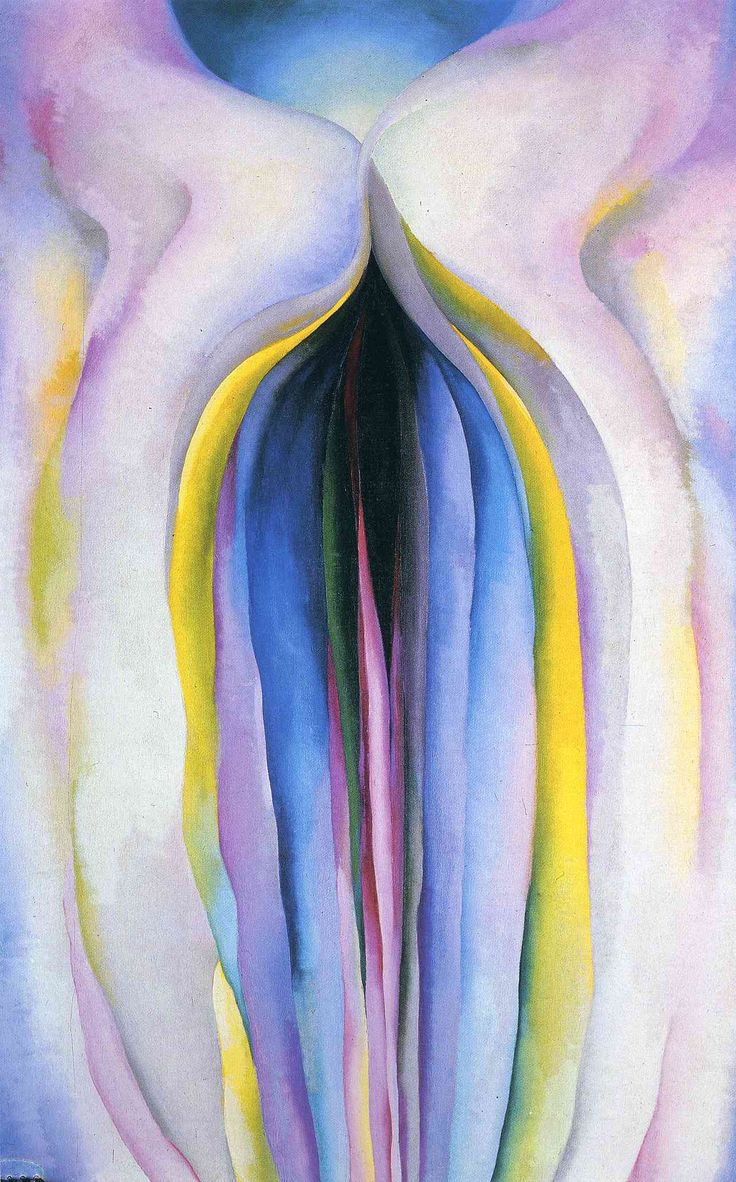
Georgia O’Keeffe, Grey Lines with Black, Blue and Yellow, c. 1923. Oil on canvas, 121.9 × 76.2 cm. Museum of Fine Arts, Houston, Texas.
Georgia O’Keeffe (1887-1986) was one of the figures linked to the development of American modernism. In 1929, she traveled for the first time to northern New Mexico, whose architecture, landscape, and natural forms opened a new stage in her work.
Her production includes abstractions, views of New York, large-scale representations of flowers, bones, trees, and landscapes of New Mexico. O'Keeffe made the careful observation of an object or a fragment of the landscape the center of the composition, modifying its scale and eliminating secondary spatial references.
11. Frida Kahlo
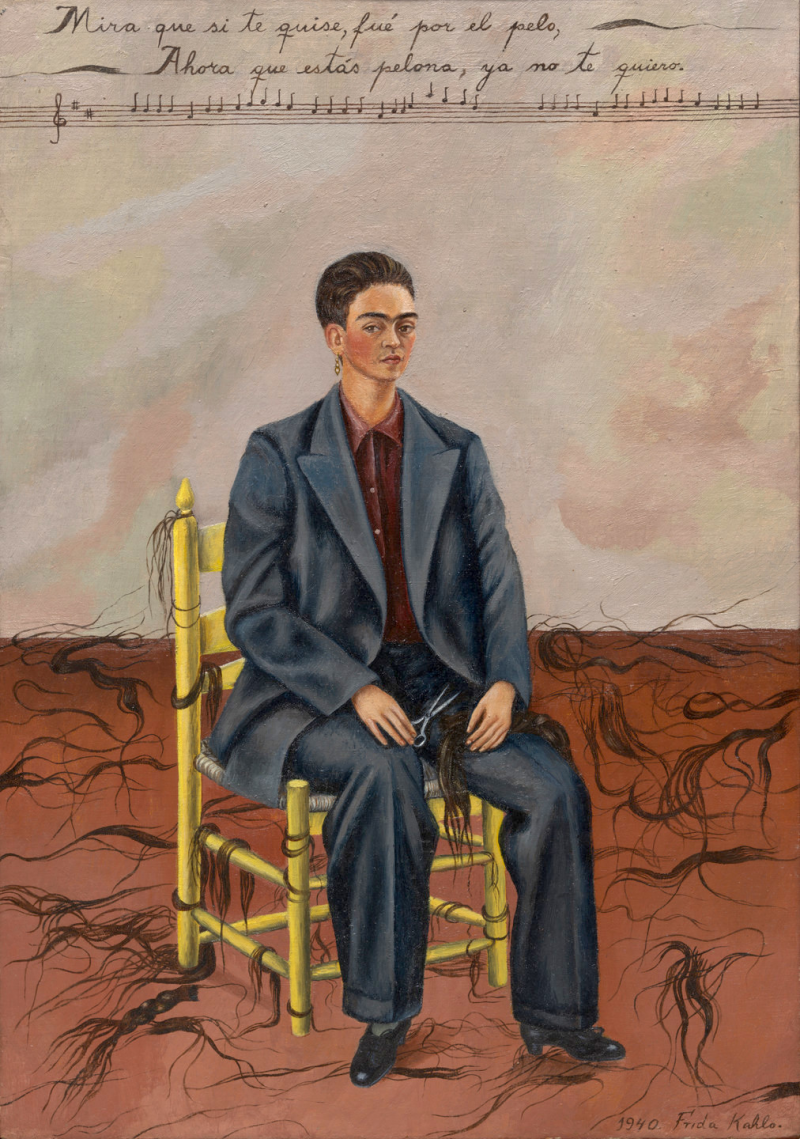 Frida Kahlo, Self-Portrait with Cropped Hair, 1940. Oil on canvas, 40 × 27.9 cm. The Museum of Modern Art (MoMA), New York.
Frida Kahlo (1907-1954) used self-portraiture to explore her body, her identity, and different episodes of her biography. In her paintings, she combined personal references with elements of Mexican visual culture and attire.
She began painting in 1925, during her recovery from a bus accident that marked her physical life. In works like Self-Portrait with Cropped Hair, she also examined conventions related to gender and the construction of her public image.
12. Leonora Carrington
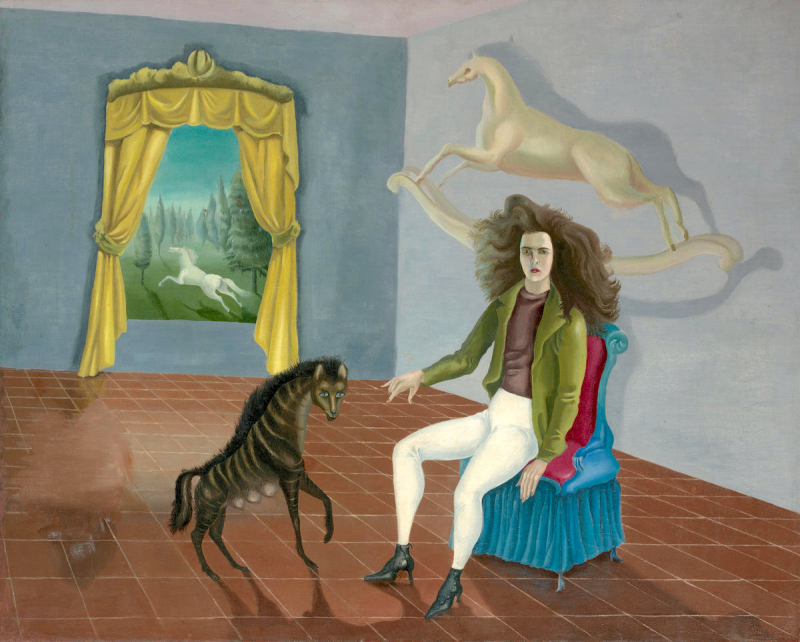
Leonora Carrington, Self-Portrait (Inn of the Dawn Horse), c. 1937–1938. Oil on canvas, 65 × 81.3 cm. The Metropolitan Museum of Art, New York.
Leonora Carrington (1917-2011) was a painter and writer associated with Surrealism. After leaving Europe during World War II, she passed through New York and arrived in Mexico in 1942. There, she joined a community of exiled artists and writers that also included Remedios Varo, Benjamin Péret, and Kati Horna.
Her paintings depict scenes populated by animals, hybrid figures, architectures, and characters from mythologies, tales, esoteric traditions, and literary texts. Her production helped to expand Surrealism beyond its initial Parisian core and its predominantly male circle.
13. Remedios Varo
.jpg?mode=max)
Remedios Varo, Cosmic Energy (Inspiration), 1956. Gouache on board, 31.4 × 30.8 cm. Signed "R. Varo" in the lower right corner. Sold at Christie's, New York, on May 18, 2026, for $4,467,000.
Remedios Varo (1908-1963) trained at the Real Academia de Bellas Artes de San Fernando in Madrid. During the 1930s, she lived in Barcelona and Paris, where she met surrealist artists and writers. In 1938, she participated in the International Surrealist Exhibition in Paris.
In 1941, she went into exile in Mexico, fleeing fascism in Europe. There, she developed the works for which she is best known, populated by characters who investigate, travel, weave, build machines, or traverse enclosed architectures. Her compositions link surrealist methods with scientific, narrative, and esoteric references.
Her recognized career is also reflected in the international market. In May 2026, Cosmic Energy (Inspiration), a gouache on board created in 1956, reached $4,467,000 at Christie's New York, setting an auction record for a work on paper by the artist. You can learn about this and other notable results in our analysis of the Spring 2026 Art Auctions.
Contemporary Female Painters with a Prominent Presence in the Market
Contemporary female artists have strengthened their presence in museums, collections, and international auctions. Although representation differences persist within the market, creators like Yayoi Kusama and Cecily Brown hold prominent positions in sales rankings and reflect the growing institutional and collector interest in their careers.
14. Yayoi Kusama
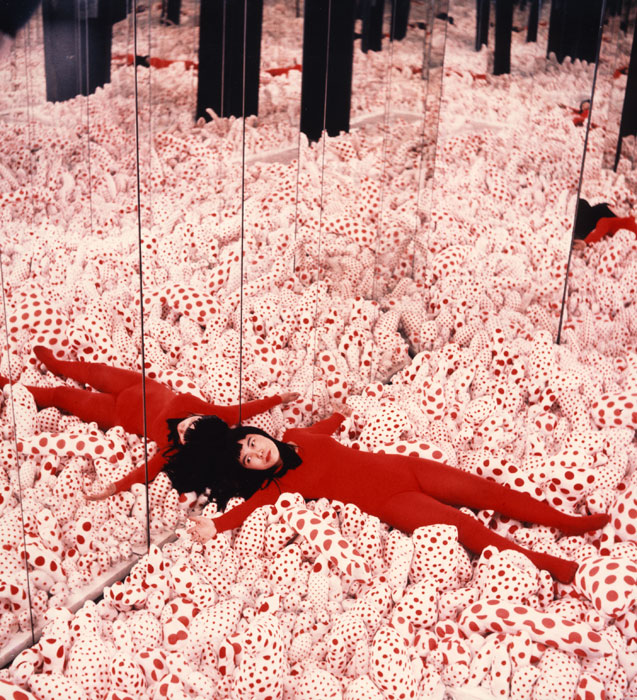
Yayoi Kusama with her installation Infinity Mirror Room—Phalli’s Field, at the exhibition Floor Show, Richard Castellane Gallery, New York, 1965
Yayoi Kusama (1929) moved from Japan to the United States in 1957. Her paintings from the Infinity Nets series are composed of the systematic repetition of small brushstrokes on large surfaces.
These works anticipated serial procedures later linked to minimalism and conceptual art. During the 1960s, she expanded her work into sculpture, performance, film, and installation. Dots, nets, accumulation, and infinity continue to be recognizable themes in her production.
15. Cecily Brown

Cecily Brown, Seven Brides for Seven Brothers, 1997–1998. Oil on linen, 193.2 × 249.3 cm
Cecily Brown (1969) was born in London and developed her career in New York. Her compositions alternate recognizable areas with brushstrokes that make it difficult to fully separate figure and abstraction.
Brown works from references from art history, including group scenes, nudes, and narrative genres. By reusing these images out of their original context, she examines how a pictorial scene is constructed and interpreted.
Her career allows us to conclude this journey with an active painter who continues to investigate the possibilities of a medium with several centuries of history.
Collecting with Perspective and Criteria
These fifteen female painters worked in very different periods, countries, and contexts. Some achieved recognition in life; others were recovered after decades of incorrect attributions, scarce institutional presence, or limited participation in traditional art history narratives.
Knowing their careers broadens our understanding of the canon and provides tools to analyze a potential acquisition with greater discernment. If you are starting a collection, want to review the works you already own, or are considering a new purchase, you can contact ArteGlobaL and request a personalized consultation without obligation. Our team will help you define objectives, study available pieces, and build a collection consistent with your interests and assets.
Incorporating a work by one of these painters also involves considering its dialogue with the space. A piece can become the focal point of a living room, an entrance hall, or the kitchen, articulating the environment and reinforcing the collection's identity.
For those who want to delve deeper into the art market and make decisions with greater confidence, The Club by ArteGlobaL offers a space for learning, meetings with specialists, and access to selected opportunities for collectors.
Sources and consulted bibliography
- Nochlin, Linda. Why Have There Been No Great Women Artists? 1971.
- The Metropolitan Museum of Art. Women Artists in Nineteenth-Century France.
- Museo Nacional del Prado. El Prado en femenino.
- Museum of Modern Art. Modern Women: Women Artists at The Museum of Modern Art.
- Tate. Women and Art.
- Museo Nacional del Prado. Sofonisba Anguissola.
- Uffizi Galleries. Artemisia Gentileschi.
- Museo Nacional del Prado. Clara Peeters.
- Museo Nacional del Prado. The Art of Clara Peeters.
- National Gallery of Art. Judith Leyster.
- Musée d’Orsay. Berthe Morisot (1841-1895).
- National Gallery of Art. Mary Cassatt, the Daring Printmaker.
- National Gallery of Art. Mary Cassatt, 1844-1926.
- Tate. Sonia Delaunay: Art, Industry and Everyday Life.
- Museum of Modern Art. Natalia Goncharova, Mystical Images of War.
- Solomon R. Guggenheim Museum. Hilma af Klint: Paintings for the Future.
- Georgia O’Keeffe Museum. Biography: Georgia O’Keeffe.
- Museum of Modern Art. Frida Kahlo
- Museum of Modern Art. Leonora Carrington and the Visual Language of Mexican Surrealism.
- Museum of Modern Art. Remedios Varo.
- Whitney Museum of American Art. Yayoi Kusama.
- Museum of Modern Art. Cecily Brown.
- Christie’s. Cosmic Energy (Inspiration) by Remedios Varo.