Collecting graphic works requires looking beyond the image: the technique, edition, state of preservation, provenance, and documentation all influence the cultural and patrimonial value of each piece. Within this field, understanding what a lithograph is allows one to distinguish an original graphic work from a simple decorative reproduction and more informed buying decisions.
In many cases, graphic works offer a more accessible entry point to the work of established or widely recognized artists in the market, without sacrificing technical rigor, authorship, or aesthetic relevance. At ArteGlobaL, we advocate that a solid collection is built with visual sensitivity and knowledge: understanding the process, history, and place of the work within the artist's trajectory allows for more conscious and well-founded collecting.
Definition of Lithography: What It Is and How It Differs from Other Types of Printmaking
Lithography is a planographic printing technique. This means that the image is not obtained from incisions or raised areas, but from a flat surface, traditionally a prepared limestone and, in modern practice, also metal plates treated for this purpose.
he process is based on a simple but very precise principle: the incompatibility between water and grease. The artist draws on the matrix with greasy pencils or inks. Then, during printing, the drawn areas accept the ink, while the damp areas repel it. In this way, the image is transferred to paper without the need to carve, bite, or lower the surface.
Here lies the main difference with other types of printmaking: in intaglio printing, such as etching or drypoint, the image is formed by grooves made on a plate, usually metallic, where the ink is deposited. In relief printing, such as woodcut, the opposite occurs: the wood is carved and printed from the raised parts. Lithography, on the other hand, does not depend on grooves or relief, but on a chemical reaction on a flat surface.
This feature explains one of its great artistic strengths. Because it does not require physical incisions on the matrix, lithography allows for a line closer to direct drawing on paper, with a gestural freedom and spontaneity that made it especially attractive to many modern and contemporary artists.
History of Lithography: From Senefelder to Modern Art
Reviewing the history of lithography allows us to understand how a technique born for practical purposes ended up occupying a relevant place within graphic works. Its evolution is linked to both image reproduction and the development of its own artistic language.
Aloys Senefelder's Accidental Invention in 1796
The technique was accidentally created by the German playwright Aloys Senefelder in the late 1790s. Unable to afford the typographic printing of his scores and plays, Senefelder began experimenting with the limestone from the quarries of Solnhofen (Bavaria). Upon discovering that limestone absorbed water and grease with identical avidity, he perfected the chemical method that significantly expanded the possibilities of graphic reproduction of the time.
The 19th Century and The Revolution of The Artistic Poster
During the 19th century, lithography established itself as an important technique for the circulation of images. It was used in illustrated publications, maps, scores, caricatures, prints, and posters, which favored an increasing presence of printed images in daily life.
The emergence and development of chromolithography allowed for color printing using several matrices, one for each tone. This advance was especially relevant for modern posters, advertising, illustrated editions, and the urban visual culture of the late 19th century.
Lithography and Modern Art

Henri Matisse in the renowned Parisian lithography workshop L’Atelier Mourlot, 1946.
With the advance of modern art, lithography ceased to be understood solely as a means of reproduction and began to occupy its own place within artistic creation. Many artists began to use it as a direct means of creation, developing images conceived from the beginning to be printed.
This difference is key for collectors: an original lithograph should be understood as a print created specifically for this technique, with its own expressive qualities and a material presence distinct from painting. In the 20th century, many artists found in lithography a flexible medium for exploring color, line, composition, and seriality, expanding the possibilities of their visual language.
How a Lithograph Is Made: The Step-by-Step Process
Preparing the Limestone and Drawing with Grease
The process begins with a fine-grained limestone, perfectly polished and levelled. The artist draws directly on the stone using lithographic crayons or tusche solutions, a greasy ink. Each mark must be made with great precision; any trace of grease or accidental mark can affect the print if it is not corrected during preparation.
Chemical Treatment With Acid and Gum Arabic
Once the drawing is finished, the stone is treated with a solution of gum Arabic and a small amount of acid, traditionally nitric acid. This treatment helps fix the greasy image onto the matrix and prepares the areas without drawing so they can hold water and repel ink.
Inking and Printing in the Lithographic Press
The stone is kept constantly moist during the process. When the roller loaded with greasy ink passes over it, the ink adheres exclusively to the drawn areas and is repelled by the wet parts. Finally, the paper is placed on the stone (or matrix) and the ensemble passes through a lithographic press, which transfers the image to the final support.
Artists Who Made Lithography Their Own Language
From Toulouse-Lautrec to The Modern Poster
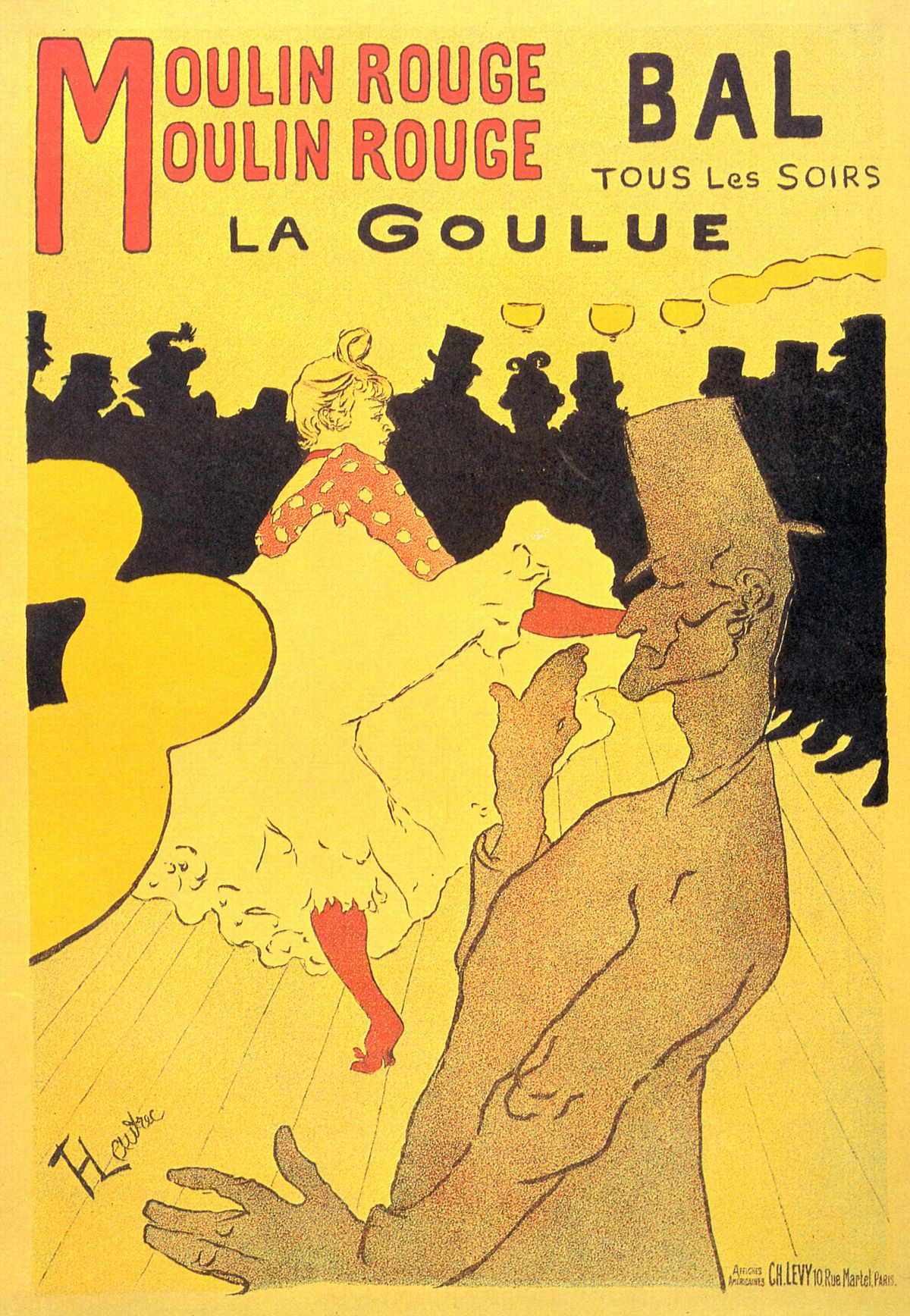
Moulin Rouge: La Goulue, Henri de Toulouse-Lautrec, 1891. Color lithograph.
Among the most cited examples of lithography in the history of modern art is Moulin Rouge, La Goulue, by Henri de Toulouse-Lautrec. Created in 1891, it was his first poster and a color lithograph designed to advertise the Moulin Rouge. Institutions like MoMA, The Metropolitan Museum of Art, and the Art Institute of Chicago recognize it as a key work for understanding the visual modernity of late 19th-century posters.
Spanish Lithography: Picasso, Miró and Dalí
In the Spanish context, lithography and graphic work played a relevant role in the trajectory of some of the most influential artists of the 20th century. Picasso, Miró, and Dalí approached printmaking from very different perspectives.
Pablo Picasso

Le peintre et son modèle, Pablo Picasso, 1954. Hand-signed lithograph, 64 × 50 cm. Edition of 50 copies + 5 A.P. Available in our store.
In the 20th century, Pablo Picasso explored lithography with particular intensity at the Mourlot Frères workshop in Paris, a fundamental reference in modern graphics, where he collaborated with master printers to expand the expressive possibilities of the printed image.
Joan Miró

Tapís de Tarragona 10, Joan Miró, 1972. Lithograph signed on plate, 44 × 29 cm. Edition of 1,100 copies. Work available in our store.
Joan Miró had an important relationship with lithography, where he was able to naturally display his universe of signs, organic forms, and color. A notable case is Tapís de Tarragona, linked to the tapestry he created with Josep Royo and which is now preserved in the Museu d’Art Modern de Tarragona. From the abstract forms of that textile work, Miró developed a graphic series with the same title, transferring to paper part of the visual rhythm and symbolic force of the tapestry.
Salvador Dalí

Salvador Dalí experimented with different procedures to apply ink to the lithographic stone. One of them was called bulletism: the artist used projectiles or snail shells filled with printing ink and fired them at large lithographic stones with a 15th-century arquebus, supported on a tripod. Afterwards, the stone marked with ink was passed through a lithographic press to obtain the impression. Dalí referred to this result as “quantified stain realism.”
Lithography Today: Collecting With Discernment
Not all prints on paper have the same artistic or documentary value. At ArteGlobaL, we recommend approaching the purchase of prints with a documentary mindset: checking the available information, assessing the material condition of the piece, and understanding its place within the artist’s career.
To explore these criteria further, you can read our articles "Numbering in graphic art: key insights for collecting with confidence" or "How to Collect Art Prints Without Losing Your Money in the Process"
If you would like to evaluate a specific piece or start a collection with professional guidance, you can request personalized advice from one of our experts. At ArteGlobaL, we help you review the technique, edition, documentation, and suitability of the work in relation to the goals of your collection.
How the ArteGlobaL Circle advises premium collectors
For high-net-worth individuals and corporate investors who wish to structure their artistic heritage without drifting aimlessly, independent guidance is vital. Avoiding impulsive purchases or inflated prices requires financial tools applied to art and privileged access to workshops and international fairs such as ARCOmadrid.
Exclusive Access: If you wish to take your cultural journey a step further and access monthly trend reports, private visits to renowned artists' studios, and personalized strategic advice for managing your legacy, we invite you to join our exclusive membership environment. Discover all the high-end benefits and sign up directly through The Club by ArteGlobaL, the space designed to professionalize your relationship with contemporary art.